




March 12 2020 was a wild day. Tom Hanks got COVID, the stock market fell 9% and we took this photo at a law office in midtown.

The exhaustion very evident after being cooped up in a midtown office for 72 hours
Moments before, I had officially signed the paperwork to sell my startup for a healthy 9-figure amount. How did it feel? Mostly relief. The acquisition took a grueling 6+ months to close — including four full months after signing a term sheet. But it was a remarkable learning experience into the mechanics of how to sell a business. Since then, I’ve helped countless other founders navigate the same journey. And I’ve written this article as a summary of the best advice I have for anyone looking to sell their company:
Full Disclosure: I’m writing this as myself, not as some investment adviser or broker-dealer representative. This is just educational stuff and my personal thoughts – not investment, legal, tax, or professional advice. While my startup Carry owns an investment advisor and broker dealer, this is not meant to be an advertisement and nothing here represents them. Financial decisions involve risk, including losing money. Taxes are complex. Please do your own research or talk to a licensed pro before acting on anything you read here. This is not a post about how to build a valuable startup. I talk about that in plenty of other places, including this article on how we scaled my last company to our first $1M in ARR. This post is specifically on how to sell your startup. A collection of lessons on how to navigate the arduous M&A process and come out (somewhat) intact.
Lesson 1: Companies are bought, not sold
The best way to sell your business is ironically to not be looking to sell your business. I love the old adage, “Run your company like you’re going to own it forever, otherwise you might just have to.” We had a lot of leverage during the M&A process for Teachable since at no point were we actively looking to sell. Our acquirer Hotmart had independently determined that they would love to own us — so the onus was on them to try and convince us to make this deal happen. This allowed us to derive a much more attractive price for the business since we didn’t need to sell… in fact, we barely even wanted to sell. In any negotiation, the party who wants it less has all the leverage. Other founders have also successfully driven up their acquisition price by driving a bidding situation between two or more interested parties. We did not do that for the reasons I outline next…
Lesson 2: Pick the best people over the best price
I have heard so many horror stories from founders after they have sold their business. I’ve heard anecdotes of:
-
Abusive work environments
-
Not receiving promised payouts
-
Constantly being at loggerheads with their new bosses
-
Painful and expensive lawsuits
A not insubstantial number of founders have their quality of life get WORSE in the aftermath of selling their business. In fact, I still receive an email like this every few weeks:
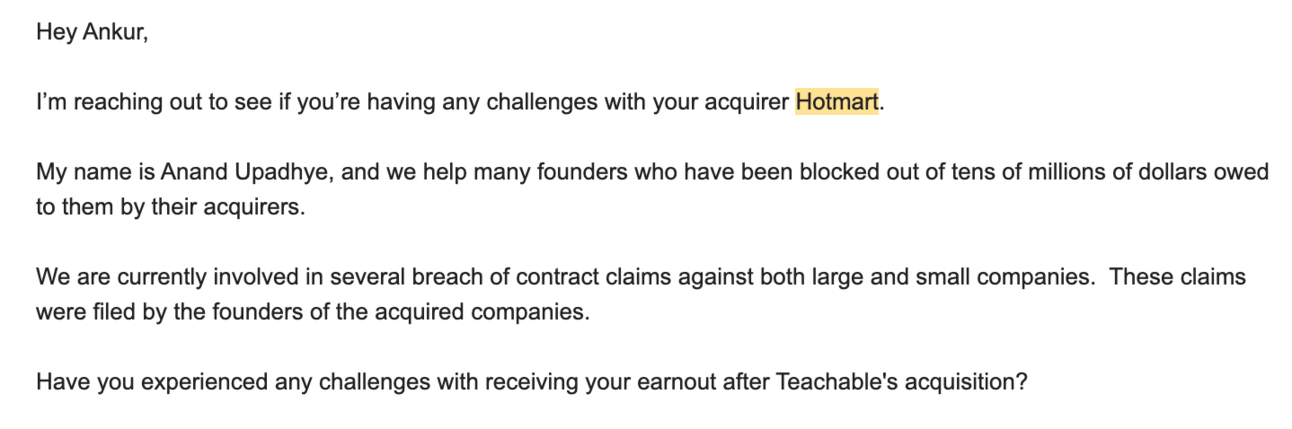
This is a very common problem no one talks about
Fortunately, I have had nothing but an incredible experience working with the Hotmart team after the acquisition. A big part of my due diligence in deciding whether to sell the company was to index on the quality of the people I was working with. Once I had conviction that the Hotmart team were good people to work with, I focused on doing the deal with them versus creating a bidding situation with random acquirers. How did I come to this conclusion? Well, they passed the vibe check… here are some things that materially helped:
-
The company was and continues to be run by the founders. There is a world of difference in founder-led companies and everyone else.
-
I spent a meaningful amount of time visiting their office in Brazil — and was blown away by the warmth with which we were received.
-
Despite the deal being put together by a private equity firm (General Atlantic), the deal structure gave the founders super voting shares and full control of the board.

Visiting the Hotmart office in Brazil for an obligatory vibe check
Once I was comfortable that we were getting a good enough price, I optimized for finding the best people to work with. An 80th percentile price with 100th percentile people sounds like a phenomenal deal to me.
Lesson 3: It’s you and the buyer on one side, both sets of lawyers on the other
Navigating the legal process of selling your company is not for the weak. This was the part of our acquisition that really dragged on — and our collective lack of experience was telling in letting it go on for as long as we did. Midway through the process, we realized that we were fully aligned with the acquirer in that we both wanted the deal to be done and papered as fast as possible. However, both sets of lawyers were happy to let the legal proceedings drag on for as long as possible. There were 7 figures in potential legal fees at stake and the slower the process, the more they made. We finally reached a breaking point in March — we had been months into the negotiation and our business had grown considerably since we started the process. I told the team we either get this done ASAP or we want to renegotiate. We decided on an ultimatum: We were all going to spend every single working hour of every single day in a conference room in Midtown until we could leave with signed paperwork. 72+ hours of being in an office got to everyone (there was very little I was not willing to trade away to see daylight again) — and we pushed through and signed the docs just before America shut down entirely for COVID. But that’s a story for another time…
Lesson 4: Everything is back on the negotiating table
I was amazed how much can be completely renegotiated at the time of acquisition. Things like:
-
The cash versus equity split that each stakeholder receives
-
How much new equity is issued to every single team member
-
Who gets acceleration of their vesting, who has to re-vest their equity
-
Bonus compensation
All of these things were being negotiated from scratch! This made me quite skeptical of certain employment clauses (i.e. accelerated vesting on change of control) because there is absolutely nothing stopping these clauses from being ignored and rewritten during the time of acquisition. It also became my job to advocate very hard for our entire team since no one else was representing them at the negotiating table. There were numerous times when opposing counsel would try and find increased “value” for the acquirer by taking value away from the other shareholders. As a founder, it is your job to fight very hard for them. When the deal is fully done, your team and other stakeholders will see the results of your efforts… and this will go a really long way in how they feel about the transaction.
Lesson 5: Insulate your team as much as possible
This was arguably the most distracting 6 months of my life. The hardest part was trying to maintain a neutral emotional state while trying to reconcile between two vastly different outcomes — either I sell my business for a life-changing amount of money or everything keeps going on exactly as usual. The last thing I needed was to distract my entire team as well. Your job as the founder is to try and insulate as much of your team from this as possible. I kept the news of acquisition relatively close to my chest — and on a “need to know” basis for as long as I possibly could. For the longest time, it was just me and our CFO — and this eventually expanded to our entire leadership team. This was harder than it seems — particularly at a company where we all worked out of the same office every day! We had to plan our visit to Brazil over Thanksgiving so it wouldn’t seem unusual for the entire leadership team to be MIA at the same time. Even then, we almost got outed by Slack’s timezone future showing the entire leadership team +2 hours from ET 😅

Not the worst place to have to spend Thanksgiving…
Emotionally, this made the process all the more difficult because it was so utterly isolating. But alas, that’s what being a CEO is all about.
Lesson 6: Until the day you receive the money in the bank, operate like the deal won’t happen
This is the most important lesson. And also the hardest. Even though you haven’t sold the business yet, your mind starts racing forward to the future state of being done already. You stop worrying about all the really hard day-to-day problems of running your business… in your mind, you’ve already sold it! Even though it will take superhuman resolve, until the literal day you receive the money from the acquisition, you need to operate as if the deal will not go through. I’ve seen far too many painful stories of acquirers backing out at the last minute, or regulatory rejections for big acquisitions — and if you mentally check out before the deal is done, it can sometimes kill your entire business. Everything you worked so hard for could be gone by getting this wrong. You have to operate your business as if the deal is not going to happen. You need to do this not just until you sign paperwork, and not just until the press release drops.

There was a whole month after the press goes out before you actually get paid
You need to wait till the actual day the wire hits the bank. And then, you can breathe.
